Showing posts with label Bird News. Show all posts

Sunday, April 12, 2009

Tell Customers To Clean Those Feeders!

Now is the time to make sure your customers are keeping their feeders clean. There are reports around the eastern US of birds, particularly finches, redpolls and siskins showing up dead at feeding stations.

The Washington Post reported that Jim Parkhurst an associate professor of wildlife at Virginia Tech's College of Natural Resources said that bird deaths had been reported in Virginia, particularly in the western and southwestern parts of the state. Researchers have reported salmonella-related bird deaths throughout the Southeast. Birds normally carry some salmonella bacteria in their digestive tracks, and periods of stress such as cold weather or food shortages can weaken their systems.

Reports of dead birds are also coming from Wisconsin, Maine, and Minnesota. When dead birds are found at a feeding station, it's impossible to say for sure that the death was due to salmonella without testing. However, given the big finch irruption reported this winter, the melting snow, and the lack of cleaning that happens at feeding stations, it's not a far stretch to speculate that salmonella is the culprit.

It's a good reminder to customers to keep those feeders clean (or at least buy a new feeder if they are not going to clean the old one).

Sunday, March 29, 2009

Bears & Bird Feeding

States on the east coast are putting out warning on bears and bird feeders. As many black bears come out of their dens from hibernation, bird feeding stations are attractive to them.

Vermont is going as far as to tell people to stop feeding birds:

"We are asking people to stop feeding birds from April through late October," said Fish & Wildlife's Col. David LeCours. "Also, don't leave pet food outside, wash down your barbecues when done, and secure your garbage containers. And above all, never purposely leave food out for bears. Feeding bears may seem kind, but it is almost a sure death sentence for them."

Massachusetts and New Hampshire are also warning to bring in feeders due to black bear activity.

Saturday, March 21, 2009

Nikon & Wild Bird Supply Sponsorship

Nikon® Sport Optics is pleased to announce its partnership with Freeport Wild Bird Supply in sponsoring the 2009 Spring Hawkwatch at Bradbury Mountain State Park in Pownal, Maine.

In 2007 and 2008, this project was sponsored and conducted by the Wild Bird Center of Yarmouth. Due to the loss of this business to fire in January, owners Jeannette and Derek Lovitch are opening Freeport Wild Bird Supply (hopefully April 1, 2009) to serve the backyard birdwatcher and birding community. Via the Freeport Wild Bird Supply, Derek and Jeannette will continue their work promoting birding opportunities in Maine, including the hawk count, which hosted 919 visitors in 2007.

This year, Freeport Wild Bird Supply is excited to partner with Nikon to continue this important project, where valuable data is collectedwhile providing an enjoyable and educational experience for visitors. "Nikon is proud to provide optics and financial support for the Hawkwatch at Bradbury Mountain State Park ", said Jon Allen, General Manager of Nikon Sport Optics.

"Supporting conservation and education is a cornerstone of the Nikon Birding Program."

As hawkcounters themselves in their previous lives, Jeannette and Derek are thrilled to help launch the field biology career of up-and- coming birder Danny Akers from Ankeny, Iowa. The project is pleased to introduce Danny as the third hawk counter for the Bradbury Mountain Raptor Research Project. He will be stationed at the summit from 9:00am to 5:00pm daily from March 15 to May 15, 2009.

The goal of the project is to document raptor migration by identifying and counting all raptors that pass by the mountain. Last spring, counters recorded 3,713 hawks, including 96 Bald Eagles, 369 Ospreys and 1,463 Broad-winged Hawks.

Over a period of years, these data can be analyzed to determine trends in species numbers as well as changes in distributions, which when studied in conjunction with other monitoring sites across the continent, give a broad scale idea of what is happening with raptor populations.

Tuesday, February 17, 2009

Scott's Recalls Wild Bird Food

Scotts Miracle-Gro Co. is keeping an eye out for birds and bird-lovers.

The Marysville-based lawn and garden giant’s Scotts Co. LLC subsidiary this week launched a voluntary recall of five varieties of suet wild bird food products over concerns that they might contain peanut meal bought from Lynchburg, Va.-based Peanut Corp. of America’s Blakely, Ga., plant. Peanut Corp.’s products have become the center of a federal probe into a salmonella outbreak that has involved scores of illnesses and several deaths, including two in Ohio.

Peanut Corp. originally only recalled peanut butter and paste but recently expanded efforts to include all peanut products made in Blakely since Jan. 1, 2007, Scotts said. The company said salmonella not only can affect animals but can pose a risk to humans who handle products tainted with it. No illnesses have been reported and products from the Blakely facility are no longer being used, Scotts said.

Read the full press release and get the list of recalled foods here.

Wednesday, February 4, 2009

Peanut Suet Safety During Salmonella Peanut Butter Recall

Four different suet manufacturers have commented regarding their nut flavored suets and the salmonella peanut butter recall. Currently, peanut butter produced from Peanut Corporation of America is at issue for salmonella contamination, not commercial brands that many of us have in our cabinets. Here are what four manufacturers have to say:

C & S states on their website that their nut suets are safe due to their testing and that they do not use any of the recalled industrial peanut butter products from Peanut Corporation of America.

Pine Tree Farms grinds their own nuts and since just the nuts themselves are not part of the recall, their suet is safe.

Woodpecker Products said that their suet is safe because they do not use peanut butter from Peanut Corporation of America.

Heath Manufacturing is also says that their suets are salmonella free since they do not use any of the recalled peanut butter products.

Wildlife Sciences says that their suet products do not contain peanut products affected by the current recall.

Cornell Lab of Ornithology said that if you do not know where the peanut butter ingredients came from in your flavored suet cake, don't feed it to birds. They did offer that since consumer grade peanut butter is currently not on the recall list, making your own peanut butter suet using ingredients you have on hand should be safe.

An excellent recipe to offer customers comes from writer and naturalist Julie Zickefoose's blog.

Wednesday, January 28, 2009

Snowy Owls Make An Appearance This Winter

Snowy owls are making quite the appearance in the eastern US this winter. The arctic species has pushed so far south, it caught the attention of USA Today.

From the Associated Press:

In Tennessee, birders armed with spotting scopes and telephoto lenses scrambled from as far away as Georgia and Alabama to see the first snowy owl reported in that state in 22 years.

The owl showed up in early December in the fields surrounding a General Motors plant in Spring Hill, Tenn. Sightings were still being posted on the Tennessee Ornithological Society's Web site in late January.

Birding hot lines lit up in northern Virginia with the sighting of a young male snowy owl in early December. The bird later died after it was found, sick and weak, and brought to the Wildlife Center of Virginia in Waynesboro.

Rarely seen south of northern Ohio, snowy owls have also been reported this year in Kansas and Missouri, according to the eBird.org national bird reporting Web site.

Snowy owls nest on the ground in the Arctic tundra and many of them stay there year-round, while some winter in Canada and the northern United States. They tend to show up in greater numbers in the U.S. every three to five years, pushed by crashes in the population of lemmings, the hamster-like mainstay of their diet.

But that doesn't appear to be the reason for this year's influx.

"This year it appears the lemming population was really good," said Laura Erickson, a biologist at the Cornell Lab of Ornithology in Ithaca. "When lemmings are abundant, snowy owls have a very successful breeding season."

As a result, the owl population grows so large that many of the young males move farther south to stake out feeding territory. An individual adult snowy owl may eat three to five lemmings per day, or up to 1,600 per year.

Snowy owls aren't uncommon in winter in Minnesota and Wisconsin, but they're far more plentiful than usual this year, Erickson said. At the airport in Minneapolis, biologists have had to trap and move snowy owls for fear they'd be sucked into a jet engine, she said.

Read the full article here.

Friday, September 26, 2008

2008/2009 Winter Finch Forecast

It's time for Ron Pittaway's winter finch forecast. Here are some highlights:

Pine Grosbeak: A mountain-ash berry specialist in winter, Pine Grosbeaks will stay north of most birders this winter because mountain-ash berries are abundant in northern Ontario. A few normally get south to Algonquin Park, but they are unlikely farther south.

Purple Finch: This finch stays in the north only when most tree species have heavy seed crops. This fall most Purple Finches will migrate south out of the province because overall tree seed crops are too low. A very few may winter in southern Ontario.

Common and Hoary Redpolls: The Common Redpoll is a white birch seed specialist in the boreal forest in winter. White birch crops are poor in the northern two-thirds of the boreal forest, but seed abundance increases southward. In central Ontario, such as Algonquin Park, crops on white and yellow birches range from fair to good. It is uncertain whether the birch crop is large enough to stop the southward movement in central Ontario about latitude 45 degrees. Some redpolls, including a few Hoarys, may get south to Lake Ontario if birch seed supplies run low.

Pine Siskin: A conifer seed specialist in winter, most siskins should leave the province this fall because the spruce cone crop is poor in the boreal forest. It is uncertain whether the huge white pine seed crop will keep some siskins in central and northern Ontario this winter.

Red-breasted Nuthatch: Movements of this nuthatch are linked to cone crop abundance, particularly spruce, white pine and balsam fir in Ontario. Good numbers of Red-breasted Nuthatches should winter in Ontario this year feeding on the bumper white pine seed crop and good spruce/fir crops in many areas such as Algonquin Park.

Blue Jay: Good numbers of jays will winter in central Ontario because the red oak acorn crop is good and beechnut crop is fair in central Ontario. Many other fruits and berries are abundant. Therefore this fall's flight should be average or smaller along the shorelines of Lakes Ontario and Erie.

Evening Grosbeak: A conifer and hardwood seed generalist in winter, Evening Grosbeaks should make a small southward movement this winter because food supplies are probably sufficient in the north. Older birders remember the 1970s when the Evening Grosbeak was a common feeder bird. Their memory is based on the greatly inflated numbers 30 years ago in Eastern Canada due to huge outbreaks of spruce budworm.

The last Algonquin Christmas Bird Count to have high numbers of Evening Grosbeaks was in 1984 with 1474 individuals, which was the North American CBC record that year. A significant decline in grosbeak numbers began in the mid-1980s because the size of annual budworm outbreaks decreased. Ontario's breeding population is currently probably stable, subject to periodic fluctuations in spruce budworm (Hoar 2007 in Atlas of Breeding Birds of Ontario).

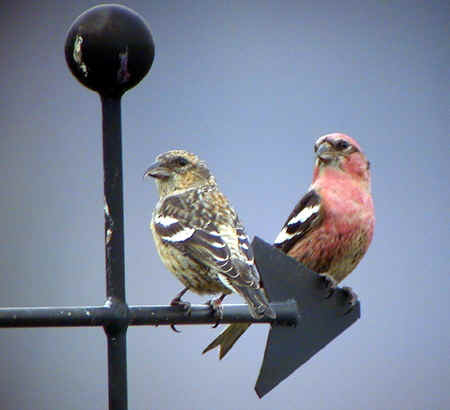
White-winged Crossbill: This crossbill wandered widely this past summer searching for extensive spruce cone crops. Reports came from Alaska, Yukon, Hudson Bay Lowlands, Ontario, Quebec and many northern states such as Michigan and New York. Most kept moving but some
stopped and their singing suggested nesting but spruce cone crops are generally not large enough in most areas to support major nestings. The White-winged Crossbill specializes on the small soft cones of black and white spruces and hemlock when bumper in Ontario. This winter they should be widespread in small numbers in traditional areas such as Algonquin Park. However, spruce cone crops are generally low in most of Canada and as seed supplies ar exhausted this fall and winter so a moderate southward irruption is probable, perhaps extending south into the central United States. Watch for them on ornamental spruces and European larch.

Read the full report here and read past Winter Finch Forecasts here.

Saturday, July 19, 2008

Some Answers To The Mealworm Shortage

From The Reptile Channel:

Nationwide, major companies producing or selling Tenebrio molitor are limiting new orders or halting them altogether. It’s creating a pinch some herpkeepers are feeling online and at the local pet store.

Production issues appear to be main culprit. Fred Rhyme, owner of Rainbow Mealworms, said his worms have been dying when they’re young. Once the chitinous insects get big, however, they do fine.

In business for more than 50 years, Rhyme said it’s the first time he’s encountered this problem. Unsure what is causing his mealworms to die, he said it might be the grain in which he keeps the insects. “We’re testing everything,” he said. “I’m trying different grains from different granaries.”

Whatever the cause, Rhyme said he’s more than 200 million worms behind in his orders, yet he hoped production would be back to normal by late July. “We’d better,” he said, “or I’m out of business.”

You can read the full story here.

Friday, July 18, 2008

A new edition of Birdwatch Radio has just been posted on-line. This program features an interview with author and bird store owner, Mike O'Connor.

Monday, July 7, 2008

Mealworm Shortage

Have you been able to get any mealworms lately?

You're not alone, most of the country from reptile owners, to wildlife rehabbers, to hardcore bluebird trail monitors are having a tough time finding live mealworms. So what happened?

Rita Smith of New York Worms answered, "It is because many of the larger growers had crop failures this spring and there is just not enough to go around now."

When asked to clarify what caused the crop failure with the "larger growers" no answer was given. I contacted The Bug Company in Minnesota, the representative said that their supplier in California who produces 70% of the mealworms for mealworm companies across the country is unable to grow them. The supplier starts them and then all the mealworms die. At this point the supplier isn't sure what the cause is for the failure to grow. Is it the bran that they are grown in? Is it a virus? No one seems to know at this point. I asked the representative for the name of the supplier and the Bug Company rep said that she was unable to give it out but would pass my questions and contact info on to their supplier to contact me.

Like many in the birding industry, I'm still waiting for an answer.

Monday, May 26, 2008

Dead Birds Reported In Minnesota In April

Late April was a tricky weather month in Minnesota for birds. Cold temperatures and heavy snows created harsh feeding conditions for insectivores just arriving from migration. From the Minneapolis Star Tribune:

The Minnesota DNR received numerous reports of dead swallows, bluebirds, sparrows, robins and warblers. Because of the cold spring, migrating songbirds found few insects when they arrived. Then the late-April snow hit in northern Minnesota. Birds that eat insects couldn't find food, and some starved.

In Brainerd, 19 dead swallows were found in nine different nest boxes. There were 27 more swallows and two bluebirds found dead in nest boxes at Crow Wing State Park,

“Citizens can help by putting out meal worms for bluebirds and other worm-eating birds. Unfortunately, there isn't anything we can do for the swallows that rely on flying insects for their main food source,” Henderson said. “Temperatures above 60 for a period of two to three days should produce enough insects to revive birds currently in peril.“

Conrad Christiansen, retired DNR biologist, said migrating birds are always pushing the snowline.

“Birds such as woodcock return about mid March,” Christiansen said. “If we experience a heavy, late snowfall some birds will suffer.“

However, some remained skeptical, according to an article in the River Valley Outdoors:

I still remain puzzled by the report. Gaylord Perry, co-owner of Wild Birds Unlimited in Onalaska, WI, agrees the DNR may be jumping to conclusion with out looking at all the facts.

Perry agrees it may be a possibility the birds are dying from starvation, but is quick to point out that most insect-eating birds will also eat seed and fruit.

“They not only eat insects, but will eat seed as long as it’s out of the shell,” he said. “They’re also fruit eaters.”

Perry said he was skeptical about bluebirds eating seeds until one of his customer brought in a photo to prove it.

“When I asked them what they were feeding the bluebirds, the customer said our garden mix,” Perry said. “Sure, everything is out of the shell in that mix.”

Rather than starvation, could the birds found in the nest boxes have died from exposure from the cold, or from predation?

Perry says those are certainly possibilities and that’s why he remains very skeptical about the report.

Monday, May 19, 2008

Farm Bill Information

From The Birding Community E-Bulletin:

House-Senate negotiators reached a tentative agreement on the long-awaited Farm Bill on Friday, 25 April. The provisional agreement on a new five-year Farm Bill was approached after another round of spending and tax cuts, and the establishment of new customs fees to meet budget rules and to win over Republicans’ support in the Senate.

Conservation measures in the Farm Bill are deemed crucial to bird-and-wildlife protection. Native prairie, certainly one of this country’s most endangered ecosystems, is suffering a heavy loss, since incentives remain in place encouraging conversion to cropland. (e.g., more than half a million acres of native prairie were lost nationwide in 2007.) A proposed provision called Sodsaver is part of the new Farm Bill. It is aimed at discouraging this destruction by removing crop insurance eligibility and other subsidies. Even the Conservation Reserve Program (CRP), long considered the centerpiece of Farm Bill conservation, is suffering as rental rates for the program are being outstripped by commodity prices (e.g., rental rates in the Prairie Pothole Region on CRP land average $31 per acre, while commodity crops are bringing in more than $150 per acre).

Details are still pending, and although refinements on some policy issues are still being made, the optimistic expectation is that Congress can complete the bill by mid-May.

We hope to have a more thorough report in the June E-bulletin.

Monday, March 31, 2008

Salmonella Outbreaks Reported

Time to remind customers to clean their feeders! Below are a couple of news stories regarding salmonella outbreaks in birds. Anyone else getting reports of sick birds? Also, here is a link to a page on the Cornell Lab of Ornithology on what to do when you see a diseased bird at your feeder.

Arkansas
- From the Baxter Bulletin:

An outbreak of avian salmonella has been confirmed in Camden. The outbreak was confirmed by the National Wildlife Health Center through bird specimens submitted by the Arkansas Game and Fish Commission.

There are other suspected outbreaks in the Little Rock area, as well. The disease outbreaks are not unusual, given the fluctuating weather conditions in Arkansas this late winter and early spring.


New York - From the Times Herald-Record:

A woman in New York reported dead redpolls under her feeder in New York. She was told that this had all the signs of the salmonella outbreak that has been killing off songbirds, especially redpolls, in the eastern states.

In New York, dead birds have been reported from the Capital region to the Pennsylvania border. The Department of Environmental Conservation has examined dozens. Cornell Cooperative Extension of Sullivan County has had about a half dozen calls in two weeks.

Salmonella bacteria can also make a person sick with diarrhea and stomach-flu like symptoms. In this case, a person could become infected by handling a dead redpoll or a contaminated feeder without gloves, or being in contact with an infected cat that might have attacked a lethargic, sick bird. If you find a dead bird, pick it up with rubber gloves. Bury it, or put it in a bag before throwing it away.

The salmonella bacteria is shed in bird feces. The birds get infected through bird-to-bird contact, or eating infected food or water. Redpolls, normally a northern bird not seen around these parts except during harsh winters when they migrate farther south for food, are the most susceptible. Other bird species, such as goldfinches and pine siskins, also can get sick. This is a fast-acting bacteria. The birds die quickly.

Thursday, March 13, 2008

Current Sunflower Price Predictions

From the Farm and Ranch Guide:

Sunflower appears to be taking competition for acres very seriously this year as bids for new crop continue to climb.

“New crop bids for 2008 oil sunflowers continue to increase in response to the increasingly bullish prices for other commodities,” said Larry Kleingartner, executive director of the National Sunflower Association. “All three crushing plants are offering Act of God contracts and the Enderlin and Fargo plants are offering a 2008 cash contract without AOG.

“With the tremendous surge in all new crop prices, the confection processors have also responded and have increased their new crop prices as well and are now offering a contract of $30 per hundredweight for all size seed production at the Northern plants,” he added.

In fact, Dahlgren recently rolled out a new crop offer of $37.50 for confection sunflowers. New crop contracts for confections in the High Plains are reaching as high as $35-$37 for the large seeds and $22 for seeds falling through a 20/64 round hole screen.

This is in stark contrast to last year at this time when new crop values were in a range of $16.30-$17.35 for oil sunflowers and confections were $19.50-$20.

“It does not look like these prices will back off in the weeks ahead as the competition for acres will continue to be intense,” Kleingartner said.

While sunflower prices continued to climb, the wheat markets' meteoric rise slowed a bit last week with spring wheat prices falling about $10 in some locations.

“It appears that a good portion of the investment money is now going into the oilseed sector, particularly the Chicago soybean oil futures market,” Kleingartner said. “That market has increased by 15 percent in the last two weeks. Sunflower prices have responded as well with most locations at or above .30 cents per hundredweight with confections at a premium to oils.”

Not all aspects of the sunflower market are surging, however, as the sunflower bird seed market is reported to be slowing down.

“Estimates are that demand will decrease from 10 to 20 percent as consumers shy away from the substantial price increase at the retail level,” Kleingartner said.

You can read the rest here.

Thursday, February 28, 2008

Keeping Birds Away From Bird Seed


From the Associated Press:
By JAMES MacPHERSON

BISMARCK, N.D. (AP) — Federal wildlife officials will target entire parcels of cattail-choked wetlands in North Dakota this year to kill the preferred habitat of sunflower-scarfing blackbirds.

Some 60,000 acres of cattail marshes in North Dakota have been destroyed since 1991 to try to keep blackbirds at bay, said Phil Mastrangelo, state director for the U.S. Department of Agriculture's Wildlife Services agency.

Last year in North Dakota, about 4,500 acres of wetlands in 16 counties were treated, Mastrangelo said. This year there will be enough money to treat about 8,000 acres, he said.

A herbicide is applied from a helicopter, at a cost to the government of about $23 an acre, Mastrangelo said. The program targets only cattails on private land and is free to sunflower farmers. Last year, 43 of them got treatment.

In past years, about 70 percent of a cattail marsh was treated with a herbicide, but blackbirds were still able to nest, loaf and roost in the remaining fuzzy-topped weeds with reedlike leaves. "That 30 percent still gave some heartburn from the blackbirds," Mastrangelo said.

The USDA estimates blackbirds eat more than $10 million worth of sunflowers each year in North Dakota, which accounts for about half of the nation's sunflower production.

"Just getting rid of cattails is a real good tool to use," said Mike Clemens, a sunflower farmer from Wimbledon, in eastern North Dakota. "If you can get rid of them within two miles of a field, blackbirds will go somewhere else to find something else to chew on."

Clemens, who has used the program for two years, said eradicating all the cattails in an area is important. "If you leave 10 percent of cattails, it's still just enough to attract birds who will still want to hang around," he said.

Some 70 million blackbirds come through the Northern Plains each year, including about 6 million that stop in North Dakota, biologists say. Each blackbird can eat about an ounce of sunflower seeds daily.

Larry Kleingartner, executive director of the Bismarck-based National Sunflower Association, said cattail eradication has been effective in controlling blackbirds. He said the loss of habitat makes the blackbirds more vulnerable to predators during nesting.

Cattails cover some 600,000 acres of wetlands in North Dakota. Mastrangelo said wetlands treated with the herbicide are typically free of cattails for about five years.

Monday, February 18, 2008

Wild Birds NOT The Cause Of Bird Flu

On the off chance anyone is still worried about Avian Infuenza, the World Wildlife Fund Chapter in Pakistan is going on record that wild birds are not the main cause:

Wild migratory birds may suffer from Avian Influenza (commonly known as bird flu), but they are not the main source of the disease’s outbreak in Pakistan, according to a study statement issued by the World Wildlife Fund (WWF) Lahore chapter on Friday.

The statement said that the statements about migratory birds being the main reason for the latest outbreak of bird flu in Pakistani poultry farms might have serious repercussions against the birds and their habitats. It said since the recent outbreak of bird flu in Sindh, WWF Pakistan had been in contact with BirdLife International, which carried out research on the role of wild birds, including migratory species, in the spread of HPAI H5N1.

The WWF said there were no sound grounds to support the allegations that migratory birds were solely responsible for the spread of H5N1. It said the Food and Agriculture Organization (FAO) collected samples from between 300,000 to 350,000 wild-birds across the world. None of these were found H5N1 positive. Likewise, sampling of 5000 water birds after the outbreak in Nigeria during 2006 found no traces of the virus (according to the Wildlife and the Environment Web). Despite increased sampling around the world, no fully documented migratory wild birds have tested positive for H5N1.

The WWF said the mapping of bird flu outbreaks across the world had shown that they followed poultry trade routes rather than the migratory birds’ flyways. Therefore, after a comprehensive critical review of recent scientific literature, it was concluded that poultry trade, rather than bird migration, was the main mechanism of the global dispersal of the H5N1 virus.

The organisation said the illegal trade of caged birds had transported the H5N1 virus the world over. It said, “Bird flu virus is transmitted farm to farm by the movement of live birds, people (especially with contaminated clothes), and contaminated vehicles, equipment, feed, and cages. Highly pathogenic viruses can survive for long periods in the environment, especially when temperatures are low. For example, the highly pathogenic H5N1 virus can survive in bird faeces for at least 35 days at a low temperature (4 degree Celsius). At a much higher temperature (37 degree Celsius), H5N1 viruses have been shown to survive, in faecal samples, for six days (WHO).”

Read the rest of the story here.

Monday, February 11, 2008

British Bird Feeding Studies

The Telegraph is reporting that a British bird survey found that more birds are found in affluent areas. Perhaps because people with discretionary income can afford more feeders and better seed? Here's an excerpt:

"Scientists say they have discovered that a high density of bird feeders and bird tables raises the overall numbers of birds in urban areas, independently of factors such as the presence of parks and large gardens.

However, the "bird feeder effect" found by researchers from Sheffield University varied markedly according to the social and economic status of the households in the area."

Read the rest of the story here.

In other British bird study news, Science Daily is reporting that feeding birds in winter gives them a potential advantage during breeding season:

"By providing some birds with extra food, such as peanuts, and leaving others to fend for themselves, the team was able to compare productivity between the two groups. Those that were given extra food laid eggs earlier and, although they produced the same number of chicks, an average of one more per clutch successfully fledged. Although it was well known that garden feeding helps many birds survive the winter, this is the first time that the benefits to spring breeding and productivity have been shown.

Dr Stuart Bearhop of the University of Exeter, corresponding author on the paper, said: "Our study shows that birds that receive extra food over winter lay their eggs earlier and produce more fledglings. While this research shows how the extra food we provide in winter helps the birds that take it, it is still unclear whether this has a knock-on effect on other species. This is something we are keen to investigate, but in the meantime I will certainly be putting out food for garden birds for the rest of the winter."

Read the rest of the story here.